
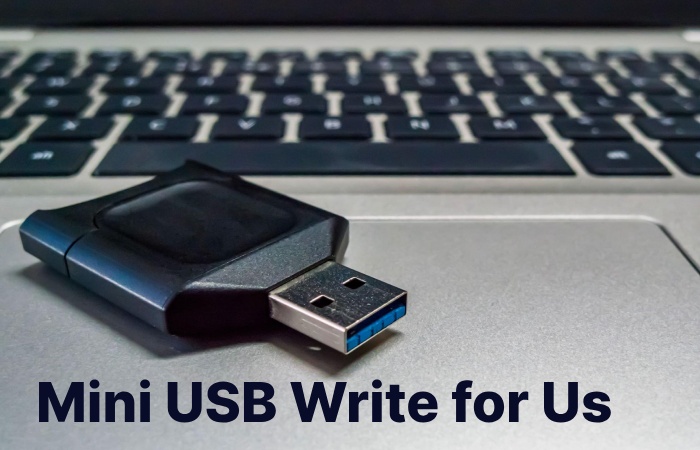
Mini USB Write for Us
Certainly, here’s an outline for an article about Mini USB technology that you could use as a starting point. Mini USB connectors have played a significant role in the world of technology, connecting devices and enabling data transfer and charging. This article researches the evolution of Mini USB technology, its current relevance, and its diverse applications.
Mini USB Technology
Mini USB technology has left an indelible mark on the tech landscape, serving as a crucial connector for many devices. As technology continues to evolve, Mini USB’s historical significance and it applications in various industries remind us of the ever-changing nature of the tech world.
Feel free to expand on each section, add relevant examples, and include any recent development related to Mini USB technology. This outline should provide a solid foundation for your article about Mini USB.
1. The Evolution of Mini USB
Briefly discuss the origins of Mini USB and its predecessor, Standard USB. Highlight the need for a smaller, more compact connector for portable devices.
2. Understanding Mini USB Connectors
Explain the physical characteristics of Mini USB connectors, including their size and pin configuration. Differentiate between Mini-A and Mini-B connectors.
3. Mini USB in Historical Context
Discuss the prevalence of Mini USB connectors in the early 2000s for various devices. Mention notable devices that utilized Mini USB, such as digital camera, MP3 players, and early smartphones.
4. Advantages and Limitations
- Advantages:
Highlight the compact design of Mini USB connectors, making them suitable for smaller devices. Emphasize their role in enabling data transfer and power charging.
- Limitations:
Discuss the emergence of newer USB standards like Micro USB and USB-C that offered improved features. Mention limitations such as slower data transfer rates compared to newer USB standards.
5. Applications of Mini USB
- Industrial Equipment:
Discuss how Mini USB connectors are used in industrial settings for programming and diagnostics. Mention the ruggedness and reliability required in these applications.
- Legacy Devices and Accessories:
Talk about the compatibility factor, where older devices and accessories still rely on Mini USB. Mention adapters and converters that allow Mini USB to work with newer devices.
6. Looking Ahead
Acknowledge that while Mini USB is becoming less common, its legacy lives on in specific applications. Predict a gradual decline as more devices transition to newer USB standards.
Mini USB technology has left an indelible mark on the tech landscape, serving as a crucial connector for a wide range of devices. As technology continues to evolve, Mini USB’s historical significance and its applications in various industries remind us of the ever-changing nature of the tech world.
Feel free to expand on each section, add relevant examples, and include any recent developments related to Mini USB technology. This outline should provide a solid foundation for your article about Mini USB.
Why Write for Webtechon – Mini USB Write For Us
- Writing can expose your website to customer looking for Mini USB.
- Web techno presence is on Social media, and we will share your article with the Mini USB-related audience.
- You can reach out to Mini USB enthusiasts.
How to Submit Guest Post?
To Submit guest posts, please read through the guidelines mentioned below. You can contact us from this website contact@webtechon.com
Article Submission Guidelines
Please review the following requirements before submitting your article.
Original content: Articles must be original, unpublished, and written specifically for our editorial review. Previously published or duplicate content will not be accepted.
Reader value: Submit informative, accurate, and practical content that answers a clear reader question or addresses a real problem.
Research and accuracy: Support technical claims with credible sources, relevant documentation, research, or practical evidence. Cite external data and acknowledge the work of other authors.
Structure and readability: Use a clear title, descriptive headings, concise paragraphs, and examples where helpful. Include screenshots, diagrams, or code samples when they genuinely improve the explanation.
Images and media: Submit original images or media you have permission to use. Provide appropriate attribution when required.
No spam or excessive promotion: Articles must not be primarily promotional, stuffed with keywords, or written solely to obtain backlinks. Product mentions must be relevant to the topic and disclosed where appropriate.
Author biography: Include a short biography of up to 100 words describing your relevant experience. An author photograph may be included if requested by the editorial team.
External links: Include only relevant, useful references. Author or website links are subject to editorial approval and applicable search-engine link policies. Publication does not guarantee a backlink.
Editorial review: We may edit accepted submissions for grammar, clarity, structure, accuracy, and style. Substantial changes will be handled in accordance with our editorial process.