
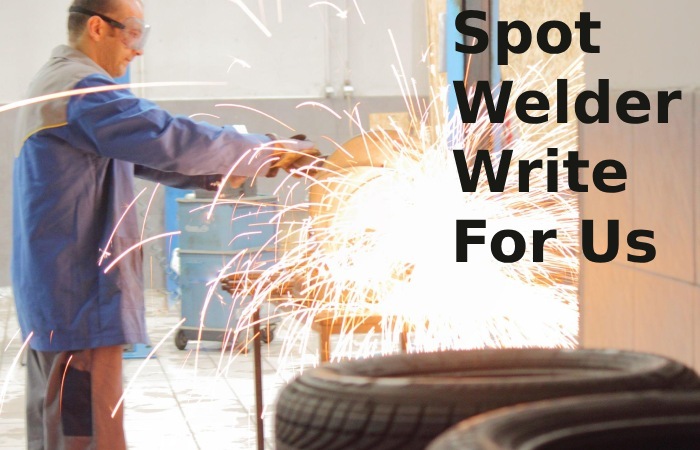
Spot Welder Write for Us
Here on this page, you can learn more about Spot Welder. Spot welding is a more complex process than regular resistance welding.
Electric spot welding is a resistance welding method. This welding technique is most often used in the automotive industry. In addition, it regularly uses to join metal sheets or sheets between 0.5mm and 3.0mm thick.
The most critical parameters of spot welding are current, resistance, heat, and pressure.
If you want to write interesting articles, we are here to publish your thoughts at webtechon.com.
How Does Spot Welder Work?
This type of welding is based on pressure and temperature. One of the metal pieces to Welder heat employs an electric current (melting temperatures) while pressure exerts between the materials to join. In this way, a durable and resistant union achieve.
The base materials arrange to overlap between electrodes. So, these electrodes are the ones that carry out the pressure and the current that corresponds to the cycle. In this way, one or several welding points achieve. Thus, the pressure must be kept constant during the cooling of the casting to avoid the creation of pores.
Advantages of Spot Welding
- This resistance welding method allows for the exact, safe, and fast joining of various material types and shapes.
- Sheet metal, profiles, bars, stamped parts, cables, or cords can weld precisely between point electrodes.
- To avoid undesired deformations on the outside of the part, the contact electrode is designed in this process in such a way that the largest possible contact area produces.
- Using multiple solder heads is a viable solution to produce multiple spot weld contacts to achieve higher bond strength and increase accuracy.
- Spot welding is a proven method of long-term welding of parts with many available weld heads.
Types Of Welding
There are two types of spot welding: unilateral welding, which based on the union of two pieces by applying electrodes on both sides of the sheets, and bilateral welding. The fundamentals of welding of this type corrupt on holding the sheets or report using local heat through a machine to melt the layer and form a weld point.
Therefore, greatest virtue of this process is that it is carried out precisely, without deformations, and achieves a good finish on the piece; All this procedure is carried out quickly by technicians specialized in industrial tooling.
Why Write for Webtechon – Spot Welder Write For Us
Writing for Webtechon can expose your website to customer looking for Spot Welder.
Webtechon’s presence is on social media, and we will share your article with Spot Welder Write for Us-related audience.
You can reach out to Spot Welder Write For Us enthusiasts.
How to Submit Guest Post?
To Submit guest posts, please read through the guidelines mentioned below. You can contact us from this website contact@webtechon.com
Article Submission Guidelines
Please review the following requirements before submitting your article.
Original content: Articles must be original, unpublished, and written specifically for our editorial review. Previously published or duplicate content will not be accepted.
Reader value: Submit informative, accurate, and practical content that answers a clear reader question or addresses a real problem.
Research and accuracy: Support technical claims with credible sources, relevant documentation, research, or practical evidence. Cite external data and acknowledge the work of other authors.
Structure and readability: Use a clear title, descriptive headings, concise paragraphs, and examples where helpful. Include screenshots, diagrams, or code samples when they genuinely improve the explanation.
Images and media: Submit original images or media you have permission to use. Provide appropriate attribution when required.
No spam or excessive promotion: Articles must not be primarily promotional, stuffed with keywords, or written solely to obtain backlinks. Product mentions must be relevant to the topic and disclosed where appropriate.
Author biography: Include a short biography of up to 100 words describing your relevant experience. An author photograph may be included if requested by the editorial team.
External links: Include only relevant, useful references. Author or website links are subject to editorial approval and applicable search-engine link policies. Publication does not guarantee a backlink.
Editorial review: We may edit accepted submissions for grammar, clarity, structure, accuracy, and style. Substantial changes will be handled in accordance with our editorial process.